[Welcome, Readers. This is probably the final section going into Paper B. In my work, I’ve found that Candida albicans is a cosymbiont and evolutionary partner that has developed through opposition. Similar to if you want to get stronger, you lift weights, an oppositional cosymbiont drives both parties forward, creating a very integrated two-in-one system. One party is self-aware; the other party is physiologically sensing and programmed to run multiple paths at once and let the paths decide which one is appropriate. This is communicated through quorum sensing. This creates two overlapping control systems. Both react to inputs; both react to the conditions the other creates. I believe this resistance training is why we are the most advanced species on earth. Not because other species did not coevolve - I believe most mammals did - but because we had a prolonged isolation with our partner over hundreds of thousands of years of Saline Oscillation in the East African Rift Valley.
Does this rule out my version conflict theory - that we evolved to some perfect state, and then diluted our physiology by admixture? I cannot say that it does or doesn’t. But here are my theories around Reciprocal Selection (a proven part of science) and how it led us to who we are.]
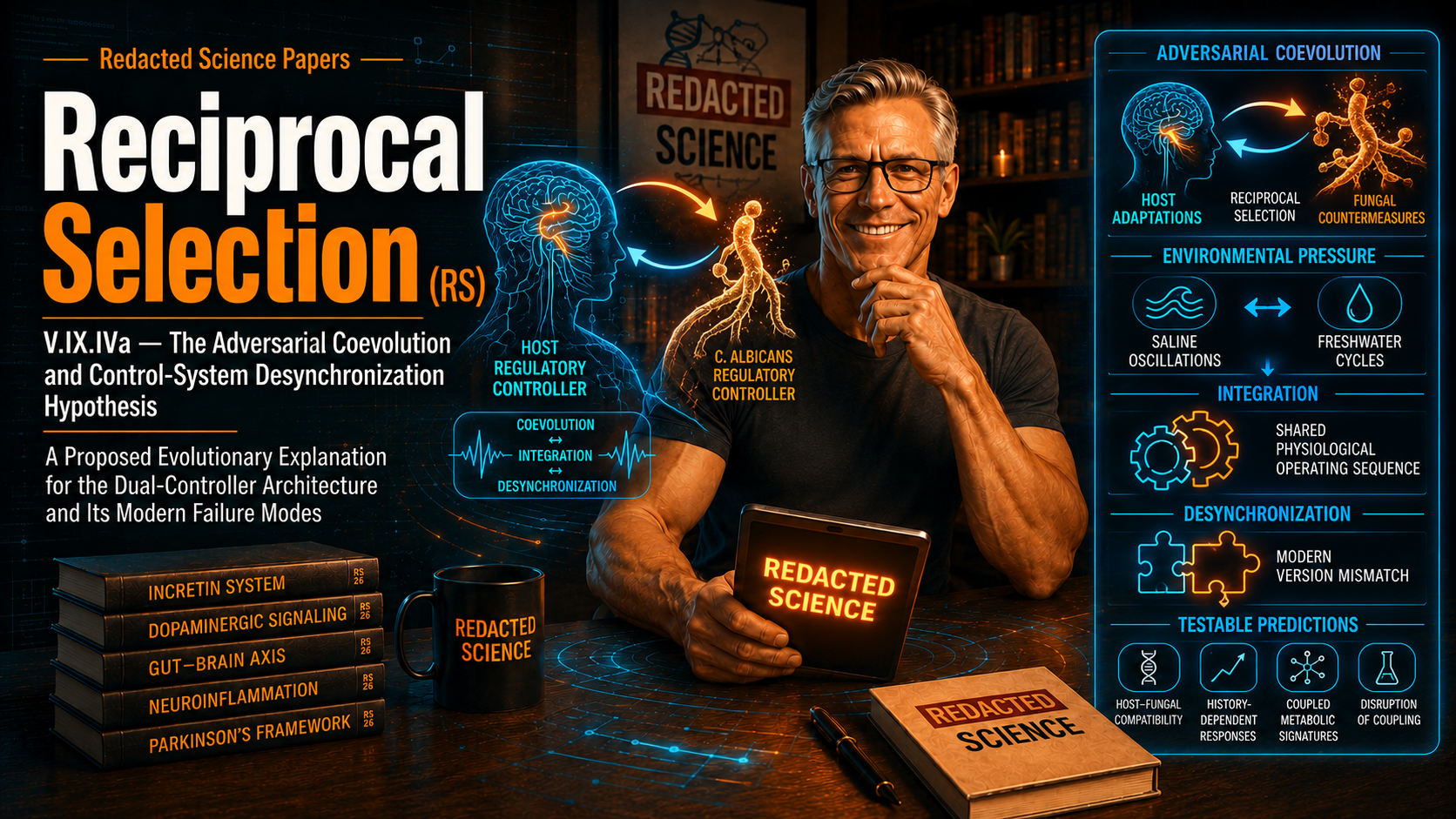
V.IX.IVa — The Adversarial Coevolution and Control-System Desynchronization Hypothesis
A Proposed Evolutionary Explanation for the Dual-Controller Architecture and Its Modern Failure Modes
The Redacted Science framework proposes that mammalian physiology and Candida albicans developed an unusually intimate regulatory relationship through prolonged coevolution.
The Saline Oscillation Hypothesis describes an environmental mechanism that could have accelerated this integration. The Pan-Mammalian Coevolution Hypothesis extends the relationship across mammalian evolutionary history.
What if the integration did not originate through cooperation, but through opposition? I see this as the most likely path.
Coevolution does not require mutual benefit. Host–parasite relationships can produce reciprocal adaptations in which each participant continually responds to the evolutionary pressures imposed by the other.
The host develops defenses. The organism develops countermeasures. Those countermeasures generate further host adaptations. Over many generations, the resulting interactions may become so extensive that the physiology of each organism reflects the evolutionary history of the other. The relationship can become functionally integrated without the underlying competition disappearing.
The hypothesis proposed here is that the biochemical computer emerged, at least partly, through adversarial coadaptation between two increasingly interdependent biological control systems.
Two Controllers, One Physiological Environment
The mammalian host possesses an established regulatory architecture governing electrolyte concentrations, water balance, circulation, immune responses, metabolism, and reproduction. The hypothalamic-pituitary axis, autonomic nervous system, kidneys, and endocrine signaling networks coordinate these processes.
C. albicans possesses its own environmental sensing and response machinery. The Hog1 pathway responds to osmotic and cationic stress. The organism regulates glycerol accumulation, proton transport, carbon-source utilization, morphology, and numerous signaling outputs. It can also influence host-cell signaling, immune responses, and the surrounding biochemical environment.
These are documented capabilities.
The Redacted Science framework proposes that, through coevolution, these fungal capabilities became integrated with portions of the mammalian regulatory architecture. The two systems would not necessarily pursue identical objectives. The host must preserve physiological function and reproductive fitness. The organism must preserve its ecological niche and obtain the resources required for continued survival and reproduction.
Nevertheless, both operate within the same physiological environment. Every regulatory action taken by one changes the conditions experienced by the other. That creates reciprocal feedback.
The host’s response to electrolyte loading changes the organism’s environment. The organism’s metabolic response may alter the chemical conditions confronting host tissues. The host responds again.
Over evolutionary time, selection could favor combinations of host and fungal responses that preserve sufficient stability for both organisms to persist.
Saline Oscillations as an Evolutionary Selection Pressure
The alternating saline and freshwater environments proposed in Paper B provide a possible mechanism for deepening this relationship.
An organism repeatedly exposed to changing salinity benefits from effective osmotic sensing and adaptation. A mammalian host facing the same changes must protect its cellular electrolyte gradients, circulating volume, and tissue function. If both organisms occupy the same physiological system, the environmental perturbation affects them simultaneously.
Neither needs to develop an entirely new regulatory architecture when salinity changes. Both controllers are already present. The perturbation activates their existing responses. The evolutionary pressure concerns how effectively those responses function together. [This is honestly fascinating from a Chemical Engineering controls perspective - two interdependent systems both controlling for their own optimization but in a living system that can evolve over time.]
Over many generations, reciprocal selection could produce increasingly coordinated timing, sensitivity, and feedback behavior. What initially represented competition might become a form of physiological interdependence. Importantly, this need not represent a permanent resolution of the evolutionary struggle. It may instead represent a dynamically maintained equilibrium.
The Homo candidus Integration
Within the proposed Homo candidus phenotype, the host–fungal relationship reached an unusually extensive degree of physiological integration.
The framework describes an ancestral operating architecture in which endocrine governance, circulation, metabolic substrate utilization, and sequential physiological transitions were adapted to the organism’s continuing presence. The essential proposition is not that the two participants stopped competing. It is that their reciprocal adaptations became sufficiently coordinated to permit a shared physiological operating sequence.
Under this hypothesis, the ancestral relationship was stable because the regulatory systems had evolved together—not because their biological interests had become identical.
Desynchronization: The Modern Version Mismatch
The framework further proposes that subsequent changes in human physiology, potentially including genetic admixture and altered developmental regulation, disrupted elements of the ancestral host configuration.
The fungal regulatory repertoire could persist while the host’s corresponding physiological architecture changed. The result would be two systems retaining components of a previously coadapted relationship but no longer responding appropriately to one another. The controllers remain coupled, but their thresholds, timing, and operating conditions are no longer synchronized.
This creates several possible failure mechanisms [See Chronic Disease as a Stuck State Program and it’s child papers]. One system may respond to a stimulus that the other no longer interprets as requiring intervention. A compensatory response may continue after the initiating condition has changed. A phase-transition signal expected by the organism may fail to appear. A host regulatory response may stabilize circulating chemistry while another compartment continues accumulating physiological stress.
The shared feedback system could consequently exhibit oscillation, overshoot, hysteresis, or persistence in an inappropriate operating state. This provides an additional evolutionary explanation for the Stuck-Program Model. Chronic dysfunction, in the proposed framework, need not arise from the absence of regulation. It may emerge from the continued interaction of regulatory systems that are no longer properly coordinated.
The original coadaptation becomes a source of vulnerability when the operating conditions change.
Mechanistic Implications and Testable Predictions
This hypothesis generates several predictions extending beyond demonstrating that C. albicans can influence individual host pathways.
Host–fungal compatibility: Different host genotypes and fungal strains should exhibit reproducibly different responses to the same environmental perturbation. Specific pairings may produce more stable regulation than others.
History-dependent responses: After controlled osmotic perturbations, otherwise comparable host–fungal systems may exhibit different metabolic or signaling outputs despite returning to the same external electrolyte concentration. Such differences should exceed those observed in equivalent host systems without Candida.
Coupled metabolic signatures: Electrolyte changes should produce correlated changes in fungal stress-response pathways and host regulatory outputs. Candidate measurements include fungal Hog1 activation, glycerol metabolism, proton transport, host epithelial ion transport, and immune signaling.
Disruption of coupling: Experimentally altering fungal signaling or removing the organism from an established model system should change the predicted host response in ways that cannot be explained by osmotic stress alone.
These relationships could initially be investigated through controlled cell-culture and intestinal-organoid experiments, using multiple fungal strains and appropriate uncolonized controls. The critical evidence would be a reproducible interaction between host regulatory characteristics and fungal genotype or activity.
Importantly, a response reproduced equally well without the fungus would not support the proposed secondary-controller mechanism.
Central Proposition and Conclusion
The Adversarial Coevolution and Control-System Desynchronization Hypothesis proposes that the relationship between mammalian hosts and Candida albicans was shaped by continuing reciprocal evolutionary pressure. Over time, opposing adaptations may have produced deep physiological interdependence.
The ancestral relationship proposed in Paper B represents a period of comparatively successful regulatory coordination. Subsequent changes in host physiology may have disrupted that coordination without eliminating the organism or its regulatory capabilities. The resulting mismatch provides a proposed evolutionary mechanism for the persistent, inappropriate operating states described throughout Redacted Science.
The existence of such a system-wide fungal controller, the proposed ancestral Homo candidus configuration, and the inferred desynchronization remain hypotheses requiring independent demonstration. Nevertheless, the model offers a unified explanation for why a relationship developed through evolutionary adaptation might subsequently become a source of physiological dysfunction.
Coevolution produced the coupling. Desynchronization turned the coupling into a potential source of pathology.
And the evolutionary struggle that produced the relationship may never have ended.
[This is the dance. This is why we are.]
[I’m documenting this from within the physiological path, as explained in my book, Redacted Science, on sale Tuesday in Paperback and today in ebook at Amazon. It has been a 31-year journey. I believe I’ve unredacted the science, but there is still much work to do. I will leave that to future researchers and the verdict on my theories to time. Honestly, much of it is certain. I’ve read the science. I duplicated it in my life to give me these 31 years. I’ve lived through 5 stages as outlined in the original Article. Explaining it is hard without the redacted literature. But, every scientific article I evaluate against the framework seems to not contradict it. If science doesn’t contradict a model, that model is science.]