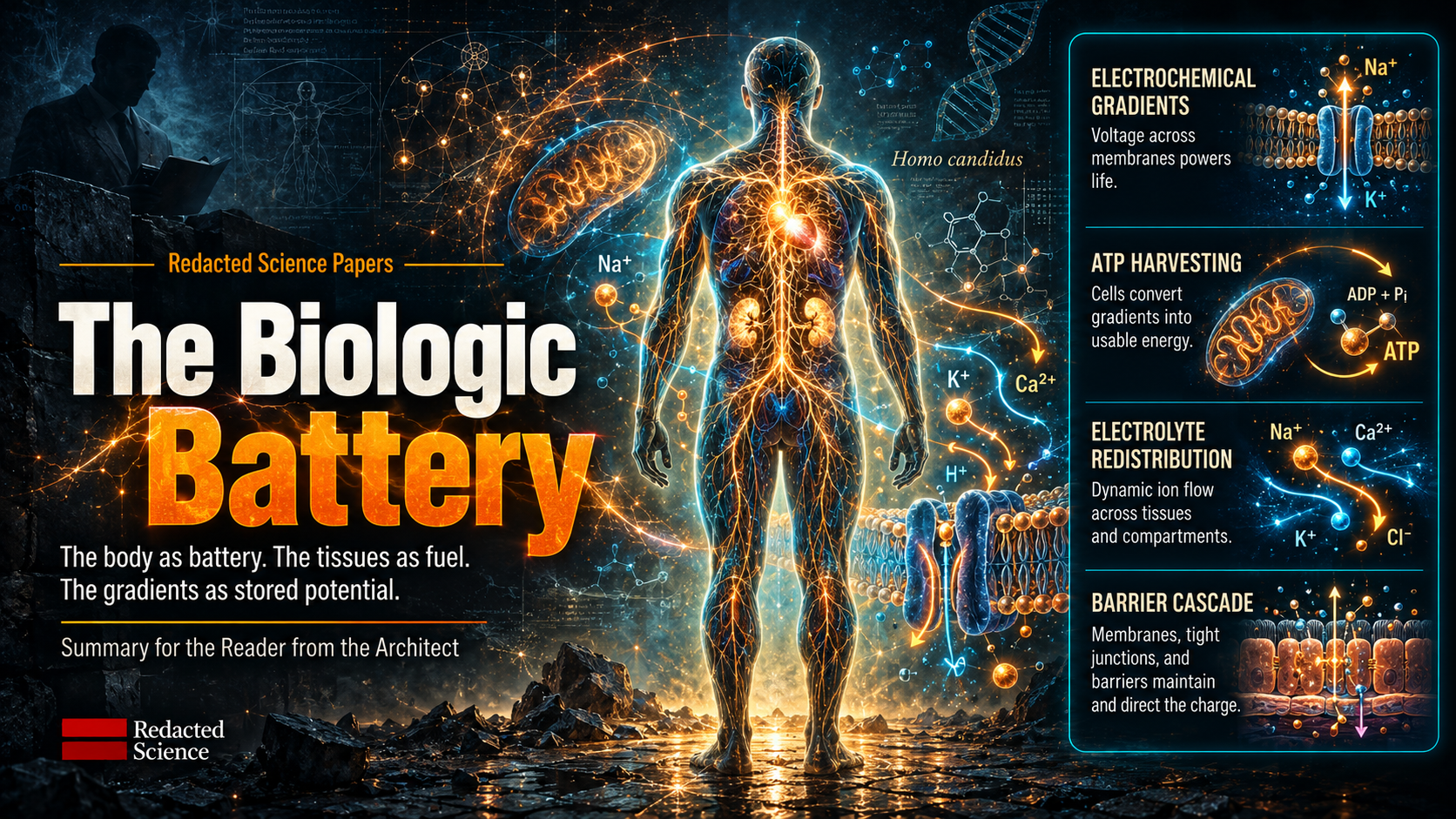
[2nd Edition Note:** This is also new to this edition, but not new to me. While editing, I realized that I had never really explained in writing this particular way of looking at the condition. It doesn’t materially change the Redacted Science Framework. Instead, it provides a way to assemble the various steps, phases, and mechanisms into something the reader can visualize. Think of it as taking thirty-one years of complicated machinery and finally stepping back far enough to see what the whole thing is doing. No, it doesn’t fit perfectly here, but it belongs in Redacted Science.]
In the Article, the Author mentioned quite early that after the initial transition, alternative energy pathways were activated and utilized. Specifically, the Author described how the body began generating energy by moving electrolytes around. That’s related to why you don’t store fat anymore. When the switch is flipped, you switch engines]
That probably sounds a little odd. How does a body generate energy by moving around what amounts to salts?
Well, that’s exactly what a battery does.
Most people think of a battery as a little metal cylinder that stores electricity. Put it in a flashlight, flip the switch, and out comes light. When the battery is dead, you throw it away. [Unless you have a drawer full of dead batteries you keep meaning to recycle]
But a battery doesn’t actually store electricity like a bucket stores water. It stores chemical potential energy, maintained through differences in chemical composition and electrical potential. Inside the battery, two different chemical environments are separated, with an electrolyte allowing ions to move between them. When you complete the circuit, chemical reactions move electrons through the external wire while ions move inside the battery to maintain charge balance.
That movement does work. The difference in potential is what makes it possible.
The important concept here is the gradient. A difference in electrical charge, ion concentration, or chemical potential between two locations represents stored energy. Allow that difference to equalize through a mechanism capable of capturing the energy, and you can make something happen. A motor turns. A light comes on. A chemical reaction proceeds.
And when the gradient is exhausted, the battery is discharged. To recharge it, energy must be supplied to rebuild the difference. [Chemical Engineering 101. Nothing magical going on here]
Now, here’s where it gets interesting.
Your body is already full of biologic batteries.
Every living cell maintains electrical and chemical differences across its membranes. Sodium is concentrated primarily outside the cell, potassium primarily inside. The sodium-potassium ATPase uses ATP to maintain that separation, pumping three sodium ions out while bringing two potassium ions in. The result is an electrochemical gradient that cells use for electrical signaling, nutrient transport, volume regulation, and muscle function.
Your nerves operate by changing membrane voltage through the controlled movement of ions. Your muscles depend on electrochemical signaling to contract. Your heart is a remarkable electrical machine, coordinating billions of cellular events through carefully regulated ion movements.
And that’s just the beginning.
Inside most of your cells are mitochondria, which operate an even more direct version of this energy-conversion machinery. They take electrons derived from the metabolism of sugars and fats and pass them through an electron transport chain. That process pumps hydrogen ions, or protons, across the inner mitochondrial membrane, building an electrochemical gradient.
Then the protons flow back through an extraordinary molecular machine called ATP synthase. Their movement drives the production of ATP, the chemical energy currency that powers cellular work.
Think about that for a moment. Your cells manufacture ATP by building an ion gradient and then allowing ions to flow back through a molecular generator. Biology has been doing this for billions of years.
Humans have taken the same principles and begun building actual biological fuel cells. In an enzymatic glucose fuel cell, specialized enzymes oxidize glucose and transfer electrons through an electrical circuit, while another reaction, commonly involving oxygen, completes the process. Glucose becomes fuel for electricity production.
There are also microbial fuel cells, where living microorganisms consume organic material and transfer electrons to an electrode. The electrons travel through an external circuit, producing usable electrical power. Researchers have built these systems using bacteria to extract energy from organic waste, including wastewater.
So yes, you can use sugar, enzymes, microorganisms, membranes, electrolytes, and electrochemical gradients to generate usable energy. We already do it, both in nature and in laboratories.
There is an important distinction between the systems. A conventional battery discharges stored chemical energy. A fuel cell continues operating as long as it receives fuel and the other required reactants. A living cell does both: it consumes chemical fuel, builds electrochemical gradients, and spends those gradients to perform work or manufacture ATP.
The gradients are the stored potential. The metabolic pathways supply the fuel. The membranes maintain the separation. And the enzymes are the machinery that makes the whole thing work. [Starting to sound a little like a biochemical computer with an integrated power supply, isn’t it?]
I’ve discussed this in general terms in my videos, but I’m not sure I’ve ever assembled it quite this way in writing.
In the Redacted Science Framework, Homo candidus is essentially operating as the most complex biologic battery imaginable. An enormous, distributed electrochemical system that can continually rearrange where energy is stored, where it is consumed, and which tissues supply the next available substrate.
ATP is harvested from cells. Different phases accomplish that in different ways, in different tissues, and through different metabolic pathways. In fact, the same location can be harvested twice using entirely different methods.
Consider the skin. I’m quite certain about this portion of the process. The skin cells are harvested, and the result is a thicker layer of skin. In the framework, that thickening is part of the tissue’s response to the ongoing process, a visible change in the architecture of the tissue being utilized.
The blood provides another reservoir. I’m confident about the blood-cell harvesting, although I have not identified every step of the mechanism. I know that glycosylated blood cells are somehow consumed during certain phases, possibly all of them, while the system continues maintaining a glucose set point. That distinction matters. The glucose concentration in the blood can remain regulated while the cells moving through that blood are themselves being utilized as substrate.
Then there’s muscle.
I know this one particularly well.
The muscle-cell phase involves stiffness and pain as the electrochemical environment changes. In the mechanism I’ve reconstructed, intracellular Candida albicans loads the cell with sodium while potassium is expelled. The normal ionic distribution becomes increasingly disrupted, compromising the cell’s membrane potential, water balance, and ultimately its viability.
The process ends in apoptosis, programmed cell death. The stiffness and pain resolve as the affected cell is eliminated.
But here’s the really interesting part.
The first harvest does not necessarily exhaust the resource.
What remains, in my model, is Candida associated with a salt-loaded cellular remnant and its membrane material. That remnant represents another reservoir, one that can be utilized during a later phase. The membrane itself contains lipids and other organic material that can serve as metabolic substrate. Breaking it down provides access to another source of chemical energy.
And when that membrane breaks down, its contents are released into the surrounding environment.
Sodium, potassium, water, metabolites, and other cellular constituents are redistributed. The local electrochemistry changes again. A gradient that existed a moment earlier has been altered or eliminated, while the released materials can participate in creating new chemical and osmotic conditions elsewhere. [The derivative changes again]
So the same tissue has been utilized twice, first through the original cellular process and later through the consumption of what remains, and even that second step pushes the process further.
[Waste not, want not. The Invader has had a very long time to perfect its recycling program]
This is the larger point I’ve been trying to convey throughout the book. The system is not simply consuming glucose, burning fat, or degrading tissue. It is continually changing the electrochemical environment in which all those activities take place. The fluids, salts, membranes, and tissues are interconnected components of a much larger metabolic architecture.
In some phases, the body is building or maintaining gradients at considerable metabolic cost. In others, established gradients are being dissipated, cellular materials are being consumed, or the resulting changes are being used to establish the conditions for the next phase.
And because this is biology, the battery doesn’t have to remain in one place. The available substrates, membranes, and gradients change as the process advances through the body.
Now consider the Barrier Cascade Theory.
The Barrier Cascade describes the entire progression as a decades-long sequence of physical barriers that fall, each failure creating the conditions that allow the next failure to occur. I’ve described this elsewhere as a biological Rube Goldberg machine, except that the process is coordinated through the ancient programming of the Invader.
Think about what those barriers actually represent.
Cell membranes separating sodium from potassium. Epithelial barriers separating fluid compartments. Osmotic gradients governing where water moves. Vascular pressure gradients controlling circulation and perfusion. Mitochondrial membranes maintaining proton gradients. Each of these structures maintains a physical or electrochemical difference upon which some part of the system depends.
Every barrier is part of the architecture that maintains those differences. Every breach changes the energy landscape.
Once you begin viewing the cascade through that lens, the transitions become easier to understand. A barrier fails, a gradient changes, cellular metabolism responds, and the next compartment inherits a new set of conditions. The Invader’s program encounters those changed conditions and executes the next phase.
The biological battery is being reconfigured as it operates.
And this is a process governed by an organism whose evolutionary history makes modern mankind look like the new kid on the block. Candida albicans possesses extraordinary metabolic flexibility, ion-handling machinery, environmental sensing, and the ability to reorganize its behavior in response to changing conditions. In the Redacted Science Framework, those capabilities are integrated into a coevolved host-organism system operating across the entire body.
The battery analogy doesn’t require every step of that program to be explained before the larger architecture becomes visible. It gives us a way to understand why electrolytes, ATP, tissue destruction, fluid movement, and successive barrier failures keep appearing together throughout the thirty-year record.
The Article said this condition was all about ATP.
Thirty-one years later, looking at the progression as a whole, I can see why.
The body is the battery. The tissues are the fuel and infrastructure. The gradients are the stored potential. And the Invader is running the program that determines how the system is used. [That’s a rather different way of looking at chronic disease, isn’t it?]

He who controls the indexing controls the memory. He who controls the memory controls the narrative. He who controls the narrative shapes intent. And he who shapes intent… rewrites the future.
-Redacted Science
https://jimcraddock.com/redacted-science-compilation.html