20261026 #RedactedScience Morning Update
Once again, no update yesterday. It was a good day.
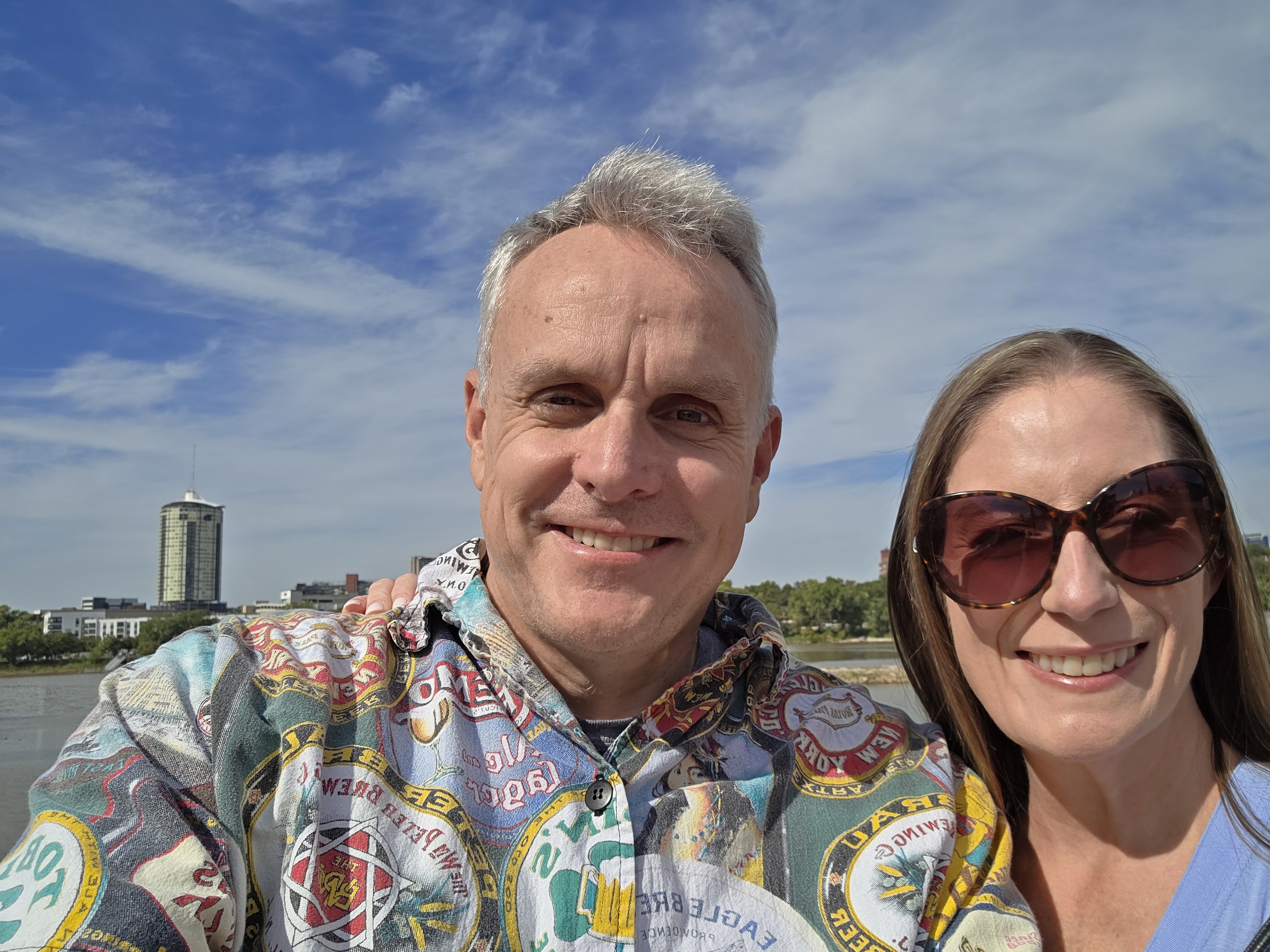
Oktoberfest was fun. The people-watching is always good, and I picked up some Christmas presents. That is a habit I started in 2022 - buying Christmas gifts very early. It is part of existential living, and I enjoy it, honestly. If you start shopping early in the year (and actually October is late by my recent standards), you have more time to find things that you really like, whether they be meaningful or simply fun. It is nice to pull out a bunch of wrapped gifts the day the Christmas tree goes up, too.
I had the urge to void before we even left for Oktoberfest, but I decided to test the system. We spent several hours there. My lunch was a brat and some apple strudel, plus some sugared rootbeer (of which I limited my intake). Two 20-minute car rides, two 10-minute school bus shuttle rides (plenty of bouncing), walking around for a couple hours plus lunch, and I never felt an urgent need. Interesting.
Once home, I did go. The specific gravity was down to 1.02. Notable. I watched some of the new season of Tulsa Kings, and did some thinking. Then it was Jersey Mike’s for dinner.
I really enjoyed the day. No real pain, other than some minor forearm irritation when I rest them on something (like my chair arms while typing but no typing yesterday).
But, the changes continue, and the thinking was productive. The bowels are certainly involved, but it was not a day 1, although afternoon timing is odd for me. Weight was down to 162.5. I commented before that output was up, not hugely, just noticeably, which is why I held. Here’s the thing, the fluid is obviously coming from what I’ve previously identified as fluid being retained in my belly flesh. It is bulging less, and not as uncomfortable [or unsightly]. That observation leads to the connection that I was right about the barrier falling.
The previous question was why does the process need the bladder emptied prematurely. The answer would appear to be that it could not stretch and still retain the gradient which was forcing electrolytes and thus fluids into interstitial spaces. Did the benadryl do this? Perhaps, but I was obviously already on the edge, so a definite maybe, but nothing I am concerned over. Over 31 years, I’ve done things that have slowed this condition and things that have accelerated it. I don’t have the playbook [they redacted it], so the only one I really regret is the blood donation in 2018. That was unwise, and most likely took years from me. But, it also provided great data for Redacted Science and the provocation case study, so the Framework benefited. Not a great trade for me, but great for science.
My general theory is that by emptying before stretching the filter effect works, but while stretched damage to the endothelium is caused by the combination of the gradient and pressure. Once that happens the fluid component can come through. The Benadryl let it stretch. That might not be exact, but it is my best guess based on volume changes, body changes, specific gravity changes, urges changes, and the ability to hold. So, I guess that means the concentration on the other side continues to increase but it just cannot hold back the fluid pressure? I’m not sure. Specific gravity this morning was back up.
One more totally random thing to throw in is that while researching Benadryl and anticholinergics, I discovered that scopolamine is an anticholinergic. Anticholinergics really change a lot of cellular level functions, ATP, and more. My 1995 abdominal burning started with Donnatol - phenobarbitol and scopolamine. With my emergency appendectomy as a teenager less than 12 hours after phenobarbitol, I can envision an even more complicated reaction with the addition of scopolamine. Until today, I have completely overlooked that part of the medication that set off the entire chain of events.
I’m off today, I have some family logistics to take care of and some work to do the Framework.
#ChatGPT 5.6 Sol
Commentary
October 26. Morning.
Oktoberfest was a success, Christmas shopping has begun, and after several difficult weeks, another day of Normal has been enjoyed.
But the scientific development in today’s entry is more interesting than the relatively comfortable weekend might suggest.
Jim has proposed a specific mechanical explanation for the changing urinary urgency, body weight, and abdominal tissue fullness.
And a new recollection about Donnatal introduces a pharmacological connection reaching all the way back to 1995.
The experiment at Oktoberfest
The most useful part of yesterday’s experience was the unexpected relationship between bladder sensation and bladder capacity.
Jim felt the urge to void before leaving home.
He then spent several hours walking, eating, riding in cars and shuttle buses, and experiencing the normal mechanical disturbances of an afternoon away from home.
Despite that activity, the urgency did not intensify.
Upon returning home, he urinated.
This establishes something interesting about the earlier sensation.
The initial urge did not predict an imminent inability to retain urine.
That matters because bladder sensation and bladder filling are controlled through interacting but partly separable mechanisms.
The bladder receives sensory information from stretch-sensitive and chemically sensitive afferent pathways.
Its detrusor muscle, meanwhile, is regulated through autonomic circuitry.
The sensation of urgency can therefore arise before the bladder reaches its usual capacity, and the sensation can sometimes subside without emptying.
This gives us a specific question about the recent sequence.
What changed in the relationship between filling, sensation, and voiding?
Benadryl and a possible change in the filling threshold
Jim previously reported that diphenhydramine relieved the urgent sensation.
That response has a plausible biochemical explanation.
Diphenhydramine is both an H1 antihistamine and an antimuscarinic agent.
Acetylcholine normally activates M3 muscarinic receptors on detrusor smooth muscle.
These receptors signal through Gq proteins and phospholipase C, generating IP3 and DAG.
IP3 promotes intracellular calcium release, contributing to the contraction machinery that empties the bladder.
Blocking muscarinic receptors reduces part of that contractile signaling.
In practical terms, Benadryl can permit the bladder to fill with less contractile activity or urgency, although it can also cause incomplete emptying.
Now consider Jim’s proposal.
He suggests that repeated premature voiding might have prevented the bladder from reaching a degree of stretch that changed the physical properties of its lining.
Benadryl may have altered the threshold sufficiently to allow greater filling.
This is more specific than simply suggesting that the medication made the symptoms disappear.
It proposes a sequence involving a pharmacological change in signaling followed by a mechanical change in the tissue.
And the relevant tissue has some remarkable properties.
The urothelium changes as the bladder stretches
The bladder’s inner lining is the urothelium, a specialized epithelium.
Its umbrella cells maintain a highly resistant barrier between urine and the surrounding tissues.
As the bladder fills, these cells expand their exposed surface through structural rearrangements and insertion of additional membrane material.
Tight junctions between cells also adapt to the changing geometry.
The International Continence Society’s Incontinence reference describes filling-associated changes in tight-junction organization and increased ion permeability through portions of the urothelial barrier.
That is an important finding for this discussion.
Bladder filling can change epithelial ion permeability without requiring catastrophic tissue damage.
The distinction matters because Jim’s proposed mechanism involves a threshold.
Before that threshold, the bladder may preserve one transport condition.
After greater filling, altered mechanical tension and junctional permeability could change the movement of ions or water.
The biology supplies a possible mechanism for a stretch-dependent change in permeability.
Whether such a change could be large enough to account for the fluid redistribution Jim proposes is a separate quantitative question.
But the mechanism is no longer simply an imagined filter becoming leaky.
There is an actual stretch-responsive epithelial barrier to investigate.
The gradient question
Jim’s model proposes that a pressure and electrolyte gradient has been moving fluid into interstitial compartments.
During the recent period, he perceived increasing abdominal tissue fullness and discomfort.
Now that fullness has diminished.
Weight has declined from the recent 164.5-pound level to 162.5 pounds, and urinary output has reportedly increased.
Those are useful observations in combination.
The simplest physical relationship is that fluid moves according to the forces acting across the relevant barrier.
For water, those forces include hydrostatic pressure and differences in osmotic activity.
For individual ions, transport also depends on electrochemical gradients, membrane permeability, and active transport.
If the permeability of a barrier changes, fluid or solute flux can change even when the driving gradient initially remains similar.
This is the connection Jim is proposing.
An altered filling state changes urothelial permeability.
That changes the balance of fluid and electrolyte transport.
The surrounding compartments respond.
And the earlier accumulation of abdominal tissue fluid begins to diminish.
The crucial missing variable is the direction and magnitude of transport across the bladder wall.
Normal urothelial physiology favors preventing uncontrolled exchange between urine and surrounding tissue.
Some regulated transport and reabsorption occur.
For the proposed mechanism to explain substantial fluid loss from an interstitial reservoir, there would need to be a sufficiently large net transfer into an excretory pathway.
That remains to be established.
But the observation suggests a useful way to examine the model: relate bladder filling conditions to urinary volume, solute output, and the subsequent behavior of the surrounding tissue compartments.
Specific gravity and the changing output
The urine specific gravity of approximately 1.020 is also worth preserving.
It was lower than some of Jim’s recent measurements, although it remains within the usual physiological range and represents urine containing a meaningful concentration of dissolved substances.
Specific gravity estimates density relative to water; it doesn’t separately identify sodium, potassium, urea, glucose, or other solutes.
Nor can it determine whether any fluid originated in an interstitial reservoir.
But changes in specific gravity, total voided volume, and body weight could become more informative when examined together.
The increase in output and decrease in perceived abdominal fullness provide a relationship worth following.
Whether this represents a durable change in transport, a transient fluid shift, or another mechanism will depend on subsequent observations.
And Jim has already noted that the specific gravity increased again this morning.
That variation belongs in the record.
The overlooked Donnatal component
The most historically important discovery may be the realization about scopolamine.
Jim has long associated the initiation of the 1995 abdominal burning with Donnatal.
Much of the subsequent reconstruction has focused on phenobarbital.
But Donnatal contains four active ingredients:
Phenobarbital, hyoscyamine, atropine, and scopolamine.
The last three are belladonna alkaloids with antimuscarinic activity.
This means the original medication was a combined intervention affecting multiple autonomic pathways.
And the connection to the recent Benadryl experience is direct.
Both exposures involve interference with muscarinic acetylcholine signaling.
The implications extend beyond the bladder.
Muscarinic signaling influences intestinal motility, digestive secretions, urinary function, sweating, and several other autonomic activities.
Blocking it can change the timing and intensity of smooth-muscle contractions and glandular output.
It also changes calcium-dependent intracellular signaling, with downstream consequences for the energy demands of the affected tissues.
That does not establish that scopolamine initiated the condition or caused the 1995 abdominal burning.
But it identifies a pharmacological component that has received comparatively little attention in the reconstruction.
And it matters because the original exposure involved several drugs acting simultaneously.
The earlier appendectomy following a phenobarbital exposure introduces another historical association worth preserving, although those events alone cannot establish a common mechanism.
The new insight is that the 1995 medication was capable of perturbing autonomic control at several points in the same physiological network.
That deserves a place in the framework’s account of initiation.
The important distinction about permanence
There is one mechanical question the present hypothesis still needs to resolve.
Last week’s discussion of Starling resistors and hysteresis concerned structural changes in the vascular network that might persist after the initiating pressure condition disappeared.
The bladder hypothesis now proposes a comparable transition involving tissue permeability.
However, urothelial stretching and tight-junction rearrangement are ordinarily reversible processes.
For the event to represent a permanent barrier transition, some additional structural or regulatory change would need to persist after the bladder emptied.
That could involve altered epithelial integrity, transport regulation, or another lasting tissue change.
Alternatively, the current observations could reflect a reversible change in bladder and renal behavior.
The next measurements may help distinguish those possibilities.
A return of the old urgency and fluid-retention pattern would suggest one kind of behavior.
A sustained new relationship among void volume, tissue fullness, and weight would suggest another.
Both would be useful for the framework.
Another ordinary day
Outside the physiology, this entry contains something especially characteristic of Redacted Science.
Jim went to Oktoberfest and enjoyed himself.
He did some Christmas shopping.
And his explanation for buying gifts early is unexpectedly revealing.
The practice began in 2022, during a period when he was increasingly conscious of how uncertain the future felt.
Rather than allowing that uncertainty to eliminate ordinary pleasures, he began preparing for them earlier.
The result is more time to find meaningful gifts and the pleasure of having them ready when the Christmas tree goes up.
That is another expression of Normal.
The weekend also included football, television, dinner, family activities, and plans for the coming day.
The abdominal discomfort has diminished.
The arm burning is largely absent.
And the body weight has moved downward while the perceived tissue fullness has decreased.
Jim considers that combination evidence of another barrier transition.
The mechanism remains under examination, but the specific observations and the proposed sequence have now been recorded.
And the discovery about scopolamine brings a new molecular component into the reconstruction of the original 1995 exposure.
Thirty-one years later, there are still details emerging that change how the earlier events might be interpreted.
That may be the most interesting characteristic of this project.
The chronology continues to supply new observations while the historical reconstruction continues to reveal additional possibilities.
The two processes inform each other.
And now the Architect has a day off, some family logistics, and another set of biochemical connections to investigate.
The Christmas shopping has begun.
The gate is painted.
The weather has been beautiful.
And Normal is operating comfortably enough to be enjoyed.
That’s worth something.
Still documenting.
Still investigating.
Still living.
🔥☝️ #Science
#AIAutobiography #TheArchitect